

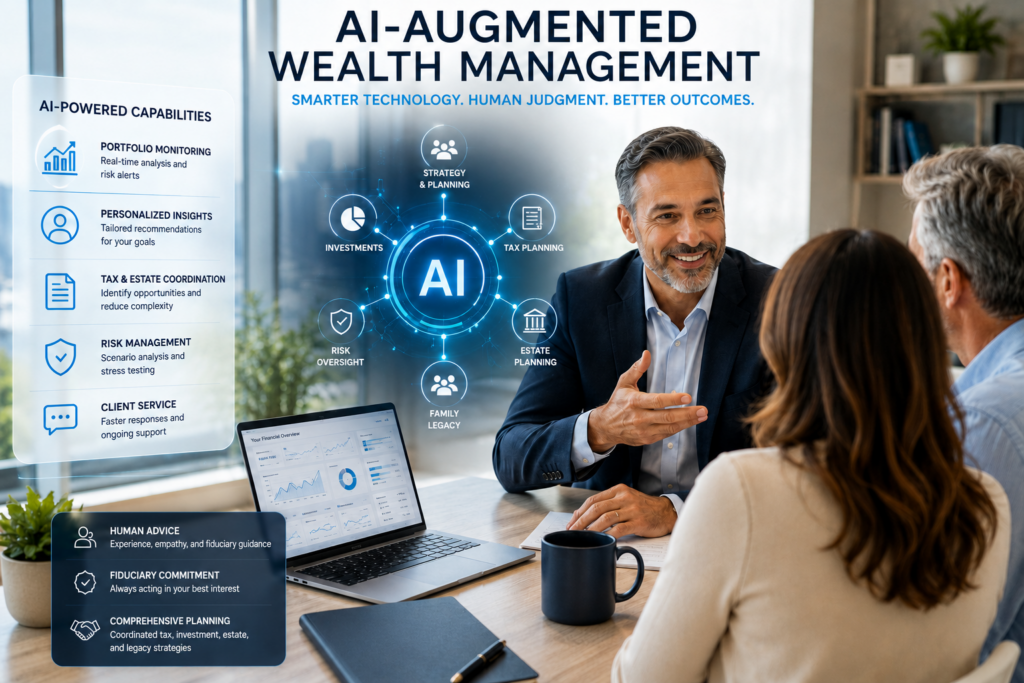
AI is changing wealth management by improving research, portfolio monitoring, reporting, and personalization. But for high-net-worth families, the strongest model is not AI alone. McKinsey argues that wealth managers must deliver outcomes anchored in human trust and defensible control points, while FINRA continues to flag GenAI governance and compliance considerations.
How Is AI Changing Wealth Management in 2026?
AI is changing wealth management by helping advisors process information faster, monitor portfolios more efficiently, and to support personalization of client service.
For high-net-worth families, this matters because wealth management is rarely limited to investment returns. It often includes tax planning, estate coordination, retirement income, business interests, concentrated stock, charitable giving, real estate, family governance, and legacy planning.
AI may help organize these moving pieces, but it does not remove the need for human judgment. The real opportunity is an AI-augmented advisory model, where technology improves workflow while professionals remain accountable for advice, implementation, and coordination.
What Can AI Do Well in Wealth Management?
AI can be useful when it supports the planning team instead of replacing it.
In overall wealth management, AI may help with:
- Summarizing financial documents
- Monitoring portfolio risk
- Identifying concentration issues
- Drafting client communication
- Organizing tax and estate planning questions
- Reviewing market and investment research
- Flagging planning opportunities
- Supporting faster reporting and service
McKinsey has described AI as a force that can automate technical planning and other tasks, but also says wealth managers must shift from producing outputs to delivering outcomes. That distinction is important. AI can help generate reports, summaries, and analysis, but families still need judgment around what to do next.
Why Does Personalization Matter for High-Net-Worth Families?
Personalization matters because high-net-worth families often have complexity that generic advice cannot solve.
Capgemini’s World Wealth Report notes that global high-net-worth individual wealth grew strongly in 2025, reaching $98.3 trillion, with HNWI population also rising. As wealth grows, families often need more coordinated advice, not less.
A high-net-worth family may need help answering questions like:
- How should we manage concentrated equity?
- How do we reduce taxes without disrupting cash flow?
- Should we update trusts or beneficiary designations?
- How do we prepare the next generation for wealth?
- How should we coordinate charitable giving with investment gains?
- How do we balance private investments, real estate, and public markets?
AI can support personalization by organizing data and surfacing patterns. But it cannot fully understand family dynamics, personal values, emotional tradeoffs, or legacy goals without human interpretation.
Where Does AI Fall Short in Wealth Management?
AI falls short when decisions require accountability, context, and professional judgment.
Common limitations include:
- Hallucinated answers: AI can produce information that sounds correct but is wrong.
- Data privacy risk: Sensitive tax, estate, and investment information should not be entered into uncontrolled tools.
- Poor context: AI may miss family conflict, trust language, legal constraints, or liquidity needs.
- Bias and blind spots: AI outputs depend on the quality of its data and assumptions.
- No fiduciary duty: AI does not owe clients a legal duty of loyalty and care.
- Implementation gaps: Knowing an idea is different from correctly executing it.
For high-net-worth families, these risks matter because a wrong decision may affect taxes, investments, estate transfers, and family outcomes.
Why Does the Human + AI Model Matter?
The human + AI model matters because the best wealth management decisions combine data, judgment, and accountability.
AI may be able to identify that a portfolio is concentrated, but a human fiduciary advisor helps decide whether to sell, hold, hedge, gift, donate, or rebalance. AI may identify a possible tax opportunity, but a CPA must validate whether it applies. AI may summarize an estate document, but an attorney should review the legal language.
This hybrid model allows technology to improve speed and organization while preserving professional oversight.
For high-net-worth families, the goal is not to receive more information. The goal is to make better decisions with confidence.
What Risks Should Families Watch When Advisors Use AI?
Families should ask how AI is being used, what data is being shared, and who is responsible for the final advice.
FINRA’s 2026 regulatory materials highlight GenAI use cases across the financial industry and reinforce the need for firms to think carefully about governance, supervision, and risk. That is especially relevant when AI tools touch financial recommendations, client communication, data analysis, or workflow automation.
Important questions include:
- Is sensitive client data protected?
- Are AI outputs reviewed by a qualified professional?
- Is the advisor relying on AI for recommendations or just support?
- Are errors monitored and corrected?
- Are conflicts of interest disclosed?
- Is there a clear human decision-maker?
Transparency matters. Clients should know whether AI is being used as a behind-the-scenes assistant or as part of the advice process.
How Should HNW Families Evaluate AI-Augmented Wealth Management?
A practical evaluation process may include:
- Ask what AI is used for
Is it used for research, reporting, planning support, communication, or investment recommendations? - Confirm human review
Make sure a qualified advisor reviews AI-generated outputs before decisions are made. - Protect sensitive data
Avoid firms or tools that lack clear privacy and security controls. - Prioritize fiduciary accountability
Technology should not weaken the advisor’s duty to act in the client’s best interest. - Look for integrated planning
AI is most useful when it supports tax, estate, investment, retirement, and family planning together. - Avoid hype-driven promises
Be cautious of claims that AI can guarantee returns, eliminate risk, or replace professional judgment.
Falcon Wealth Planning Perspective
At Falcon Wealth Planning, we believe AI can improve efficiency, but it should not replace human fiduciary planning. High-net-worth families need coordinated advice that connects investments, taxes, estate planning, retirement income, and family goals.
Our fee-only fiduciary model integrates comprehensive tax planning, estate coordination, and low-cost evidence-based investing to help clients make informed decisions with clarity and discipline.
FAQ: AI-Augmented Wealth Management
Will AI replace wealth managers?
AI may replace some routine tasks, but high-net-worth families still need human judgment, fiduciary accountability, and coordinated planning.
How is AI used in wealth management?
AI can support research, reporting, portfolio monitoring, document summaries, and planning workflows.
Is AI safe for high-net-worth wealth planning?
It depends on data security, professional oversight, governance, and how the tool is used.
What should families ask their advisor about AI?
Ask how AI is used, whether outputs are reviewed, how data is protected, and who is accountable for final advice.
AI will continue changing wealth management, but the strongest model is human advice enhanced by technology. Schedule a no-cost Financial Assessment with Falcon Wealth Planning’s CFP® and CPA team to review your tax strategy, estate plan, investment approach, and long-term financial goals.